
Product Categories
News
Contact Us
Tel: +86-0371-65621392Fax: +86-0371-86616825
E-mail: info@haomei.biz
Address:No.14 Waihuan Road, New district, Zhengzhou, China
ZIP: 450046

Structure of Mobile Concrete Batching Plant
Writer:Admin Time:26/10/29The defining feature of a mobile concrete batching plant is its integrated structural design, which consolidates the full production capabilities of a stationary concrete batching plant onto a towable chassis. This enables rapid, foundation-free deployment and flexible relocation. Taking the YHZS series mobile concrete plant from Haomei Machinery as an industry benchmark, the equipment is divided into six functional modules. These modules are pre-assembled and tested at the factory, requiring only power and water connections on-site to begin production—making them ideal for infrastructure projects in remote or dispersed locations.
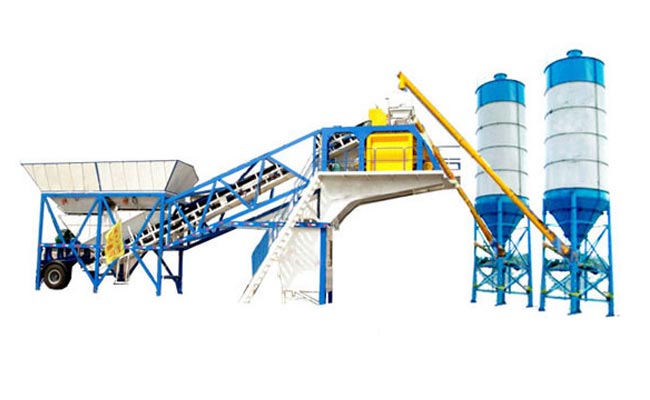
The towing and support chassis serves as the structural foundation of the mobile concrete batching plant. The frame is constructed from high-strength, low-alloy Q345B steel and comes equipped with heavy-duty axles, a front towing pin, and a lighting system, ensuring compliance with road transport regulations. Taking the YHZS35 model as an example, the entire unit can be towed at speeds of 40–50 km/h, making it suitable for transport on both standard highways and rural access roads. The chassis is equipped with four hydraulic outriggers, each offering an adjustment stroke of 300 mm, allowing the unit to adapt to site slopes of up to ±12°. There is no need to pour a concrete foundation; the plant can be leveled and positioned directly on any flat, hardened surface. Drawing on over a decade of export experience, the integrated welded chassis design can reduce on-site commissioning time by more than 60%—a significant advantage for overseas projects where labor costs are high and skilled installation personnel may be in short supply.
The aggregate batching and conveying unit is responsible for the storage, proportioning, and elevation of aggregates. The system is equipped with a PLD-series multi-compartment batcher, typically featuring 3–4 independent bins, each with a capacity of 2–6 m³. Pneumatic arc gates at the bottom of the bins allow for sequential material discharge according to preset mix designs. Aggregates are transported via a flat belt conveyor to an aggregate weighing hopper, then elevated by an inclined belt conveyor—typically set at an 18° angle—to a collection hopper atop the main mixing unit. The entire conveyor system features an enclosed design to minimize dust emissions. The YHZS35 mobile concrete batching plant is equipped with a PLD1200 three-bin batcher, capable of storing three types of aggregates—sand and two varieties of crushed stone—to meet standard concrete mix requirements.
The twin-shaft forced concrete mixer serves as the core component of the entire plant. The YHZS series mobile concrete batching plant utilizes JS-series twin-shaft forced-action mixers, with specific models matched to production capacity: YHZS25 uses the JS500 (500L nominal discharge capacity), YHZS35 uses the JS750 (750L nominal capacity), YHZS90 uses the JS1500 (1500L nominal capacity). Inside the mixer, two mixing shafts rotate synchronously in opposite directions, driving high-manganese steel mixing blades and lining plates. This generates a triple-action process—shearing, convection, and compression—applied to the materials. The standard mixing cycle is 60 seconds, and the lining plates have a service life of at least 80,000 batches under normal operating conditions. The mixer can handle crushed stone with a particle size of up to 60 mm and rounded gravel (pebbles) up to 80 mm.
A multi-stage weighing system ensures the precision of concrete mix proportions. The weighing system is divided into four independent units: aggregate weighing, powder weighing, water weighing, and admixture weighing. Aggregates are measured using a cumulative weighing method, with accuracy controlled within ±2%. Powders—such as cement and fly ash—are transported via screw conveyors into a dedicated weighing hopper, while water and admixtures are measured in their own specific weighing vessels. Both powder and liquid components achieve a weighing accuracy of ±1%. All weighing units are equipped with a high-precision load cell that transmits data to the electrical control system in real time, with automatic correction and alarms triggered in the event of deviations.
The electrical control and environmental protection auxiliary systems ensure stable equipment operation. The electrical control cabinet is integrated into the side of the main unit and features an IP54 protection rating. It houses a PLC and a touchscreen interface, enabling fully automated control over the entire process—from batching and mixing to discharging. The system supports recipe storage, production data logging, and self-diagnostic functions; for export markets, the operating interface can be customized in multiple languages. Environmental protection features include a pulse-jet dust collection system, a centralized lubrication unit, and safety guards. A pulse-jet dust collector is standard equipment for the silo top, keeping dust emissions below 10 mg/m³. The centralized lubrication system automatically applies grease at scheduled intervals, reducing the need for routine manual maintenance.
The structural design of the mobile concrete batching plant centers on three core concepts: integration, mobility, and rapid deployment. Its various modules work in synergy to execute the complete concrete production process. The YHZS series mobile concrete batching plants from Haomei Machinery has been proven in projects across more than 50 countries. Its design is mature and stable, and it can be customized to suit specific operating conditions, effectively meeting the requirements of diverse infrastructure projects abroad.
- Previous:Mini Mobile Batching Plant Price...
- Next:Mobile Batching Plant Prices...